errant thoughts on amsterdam coffee festival 2026
this post isn't really about coffee
The Amsterdam Coffee Festival took place in April this year. I'd somehow completely missed the existence of this event in 2025, so this was my first year. Well, unless you follow a cafe or roaster attending the event, you'd probably never come across it, even if you follow coffee in general.
Before we get to specific observations, I'd like to quickly touch on some more base or maybe obvious (to others, certainly not to me) sights. The first is Amsterdam-Noord itself, it was my first time being north of Centraal and my first time taking the ferry. I took the wrong one, landing me close to Eye Filmmuseum instead of NDSM where the festival was. Then I decided to walk to NDSM instead of taking the ferry back to Centraal and back to NDSM.
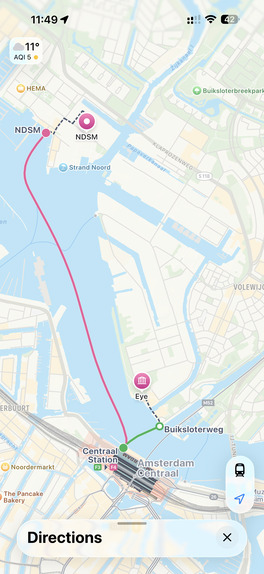
As you may know, there isn't anything to be gained from walking through Amsterdam-Noord for 40 minutes.
The event itself takes place in a fairly large warehouse-type space, though it wasn't as large as I was expecting. It had been talked up to me by some strangers at a coffee tasting event at DAK in May 2025, so I'd been looking forward to it for quite some time. I ended up getting the afternoon ticket for the Friday, which allowed me attendance from 1pm to 5pm. As I walked around the place, I was surprised both by what I saw and what I didn't see.
My own preferred style of coffee may have clouded my judgement, but I was surprised to find companies like Oatly and Monin with large booths and cameras and professional setups, as I'd have previous considered these to be coffee-adjacent as best. Perhaps the connection is obvious to some, but Oatly weren't even serving coffee that day if I recall correctly. Also astonishing was the presence of Starbucks, as well as the popularity of their booth. Who comes to a coffee festival and then defaults to Starbucks? Not me, I did not interact with this stand.
Perhaps even more astonishing was the lack of known local giants such as the aforementioned DAK as well as names like Uncommon and Friedhats. Maybe they don't need the publicity? Maybe the booths aren't worth their time? I'm not really sure. I'd like to shoutout the folks from FuFu/Mellow as they are simply the best, and will nerd out over coffee with you for as long as you want. They hosted a Taiwanese coffee cupping, which was super fun and my first time trying Taiwanese coffee. As per usual, I ended up buying a bag of coffee from them.
the meat and potatoes
the toilets
The toilets at this event were split into "Men" and "All Genders". Maybe there were people who appreciated this arrangement but I found it strange, how can "Man" exist separately from "All"? "Man" is not even a gender term. The "Men" bathroom contained a couple of urinals and a couple of toilet seats. The toilet seats were mostly unoccupied. The "All Genders" toilet contained toilet seats only, and a long queue of women waiting to use the toilet. De-facto nothing has changed, maybe there are people who felt safer going into the "All Genders" toilet, if so that is good I suppose. The very next day I went somewhere where one toilet was designated only by an image of a toilet seat and the other by an image of a toilet seat and a urinal. If only by the measure of throughput, it was a better arrangement. Perhaps my own ignorance is showing here, but I'd imagine there are people who might not self-identify with "Man" who might still use a urinal. This seems to be a poorly thought-out faux-progressive half-measure.
the tea
Although I complain about the types of entities present at the event, I actually find the presence of tea quite pleasant. It serves as a nice break from coffee and as a way to entice non-coffee drinkers to attend the event.
Anyway, the main point here is tension between the different ways different tea cultures are presented (or are being presented). There were a couple of Chinese tea booths, being run by Chinese people, where the focus was on the authenticity, the origins, the diversity of Chinese tea, how it's pure, unadulterated, the real deal etc. One woman was very happy to see me recognise gong-fu style brewing being the method of choice and I had a nice conversation with her about the oolong teas I've got at home. They're selling tea and tea equipment and a story. For the booth I interacted with, see here.
Against this were four companies selling Chai. Each of these puzzles me. I'm going to tackle them all because I'm annoyed. I will preface this with a concession: I didn't try any of the products on offer here (and indeed that's not the point), because I do not consider them to exist within the category of Chai. Also the pages in Dutch were read through Google Translate.
DEM GOOD CHAI
DEM GOOD CHAI sells Chai premixes and concentrates.
The founder recalls his story of backpacking in Tamil Nadu (I find this practice dubious, but a topic for another day), the heat is cracking, no-one speaks English(???) and he learns to make Chai from a roadside Chaiwallah. He doesn't need to tell us where in Tamil Nadu he is, the reader won't care, the mention of Tamil Nadu as opposed to a generic "India" provides the necessary claim to legitimacy here.
He describes his anticipation as Indian people validate his exploits, worrying that he's desecrating something "sacred". In the same breath that he claims not to be captivated by "a romantic idea of exotic tea, but by the deep dedication" he describes being "incredibly honored" at holding a spoon.
Here, I think, is the heart of Western appropriation: in this mode only the appearance matters, i.e. if the thing tastes the same it is the thing. The process and culture don't matter.
It doesn't occur to our dear founder that when he writes about his vegan Chai concentrate that is prepared by extracting ingredients using sound waves at 40 degrees he is no longer talking about Chai. He is no longer talking about the chaiwallah on the streets of Tamil Nadu. Perhaps he never was. His claim to legitimacy (whose need and construction are themselves his own creation) is undermined by his own process. What I mean here is that legitimacy is only needed as a function of marketing, and as such the existence of Chai, the Chaiwallah and indeed India exist only as a figment of this function, which itself is situated within a desire to experience something real. However, it is this desire for reality which transforms the real into irreal.
How can the product (and experience) of the humble roadside chaiwallah be transformed into a 33 EUR "premium, high-end" concentrate bottle? Are we talking about the same thing?
This product is marketed as being organic and vegan. How a tea mix could ever be anything other than at least vegan is beyond me.
NOMADSCHAI
NOMADSCHAI sells Chai premixes and concentrates.
This founder nobly notes the international rise of Chai and strives to "introduce a chai brew that baristas could actually use". Of course, making Chai is too difficult in Europe and the herculean effort of the roadside Chaiwallah is not replicable in a cafe. Must be something in the water.
She also mentions Chai latte, which, after drinking myself I still don't know what it is or is trying to be. At least there isn't a journey to the east here.
MamasChai
MamasChai sells a ready-to-drink Chai product that is vegan.
Our two sisters here have a heroic mission: introduce the Netherlands to real Chai. One founder has a husband with family in India, so when she visited them, she "discovered" what authentic masala chai tastes like. Of course, authentic masala chai doesn't exist in actuality, but that doesn't sell a product pitch. Authentic and vegan are two incompatible topics where Indian tea is concerned, but it's fashionable in the European market, so who cares.
Chalo
Chalo sells a large variety of Chai premixes.
Our founder here is Indian but presumably born and raised in Belgium. She "discovered" Masala Chai during a 3-week volunteering trip to India. Apparently, Chai in India unites the "highly segregated Indian society". Someone should tell the Indians! Don't worry though, Chalo is "empowering you to make a difference", and has direct links with Indian farms. Which Indian farms? This is not mentioned.
Don't worry! By buying Chalo you are funding "your rebellion, one cup at a time". Chalo cuts down the middleman and has headquarters in Belgium, the UK, the US and the UAE. But not India. Don't worry about having to put in any effort either, as "Chalo turns the traditional Chai recipe into an easy fix". Ah yes, Chai needs fixing; I must have missed that memo.
I think I started losing the plot a bit, so I'll try to tie it altogether here.
The concept of Chai exists for me as a haze; Chai is not something to be rescued from the haze, it is the haze. Its very imprecision is its beauty. The fact that Chai differs from place to place is its strength.
In the same way that no one pretends that instant coffee is the same as espresso (if you're not a coffee fan, you can say you don't like either of them, but that's not the same as being the same), why is Chai premix or concentrate still Chai (or sold as)? I think it's interesting to look at which (and whose) practice is framed as being "too difficult" and whose isn't. In whose practice is the difficulty part of the reward (see: elaborate tea ceremonies), and in whose is it a technical deficit, one which can be solved by a Western technological invention?
Who is speaking and who is being spoken for? India here (and Indian voices) function only a token of approval to a product, although inspired by something Indian in inception, that exists solely within the mind of the Occidental subject.
the coffee
Lastly, I arrive at something which was thus far unknown to me in the world of speciality coffee, and that's organic coffee. At the booth of BLOMMERS I came across a bag of Ethiopian coffee with the EU organic label 'NL-BIO-01'. The person behind the booth kindly explained to me that, actually, it wasn't that unusual, but that the challenge comes from the entire chain needing to be certified to EU standards. He explained that specifically for Ethiopia, many farms already employ organic farming practices, just they're too poor to afford the certification, which must be performed by one of the EU approved control bodies and paid for by the farmers.
This situation might remind you of Fairtrade International, whose mark is often seen on coffee and chocolate in supermarkets around the world. Fairtrade is kind of infamous for being not-that-great, they themselves admit their premiums don't result in living wages for their farmers. I'll just mention here that speciality coffee usually doesn't touch fair trade, instead favouring direct trade agreements where a roaster has trade agreements with a specific farm or set of farms. These agreements usually pay between 2x and 5x the fair trade prices, though I am still not sure if that constitutes a living wage.

Now BLOMMERS gives us some traceability information on their coffee, and the specific coffee I was looking at came from SNAP Speciality Coffee in Ethiopia. I reached out to them, asking for more information on the certification process and local outcomes, but did not receive a response.
Though the usual claim is that such certifications allow farmers to sell their produce at a higher cost (especially when they are already farming organically), I wasn't able to find concrete sources verifying this claim. This paper claims that outcomes for farmers in Ethiopia are pretty limited:
we estimate that these premiums would only lead to an increased income for coffee farmers of 22 USD per year even with a perfect transmission scenario
I was pretty disappointed by the lack of a full transparency chain. Some big roasters like Tim Wendelboe have yearly transparency reports, though for me these crucially also lack qualitative judgements about the quality of life of the farmer. Wendelboe is pretty well-known for having a close relationship with his main farms (see: blog posts like this one) where he outlines his entire interaction with a given farm.
Together with the amount of money he pays the farms, perhaps we can learn something about the quality of life of the farmers. I'm not sure, because he goes this far but doesn't actually tell us how the lives of the farmers have improved (okay sometimes he mentions jobs were created etc. but where are the details?) instead choosing to focus on how the coffee has improved as a result of his guidance.
There's been a big push on sustainability in the coffee industry in the last few years, and I love coffee. But I'm just not buying the programme yet.